

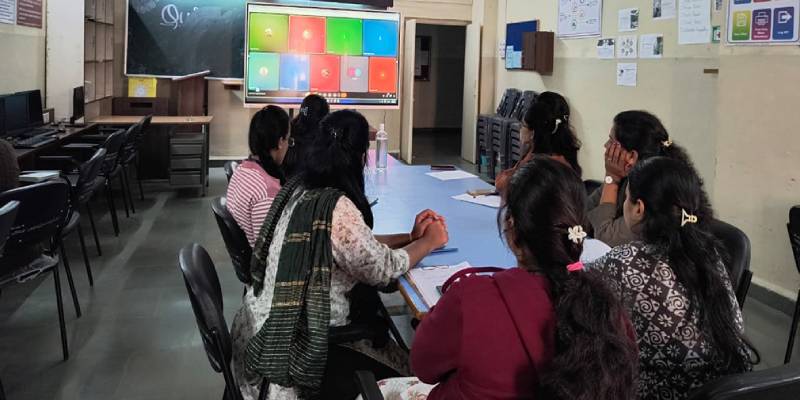
Date of Workshop: 2nd December to 6th December 2025 | Mode: Online 10.00 AM to 12:00 PM
Resource Person/ Facilitator:
Department of Computer Engineering, Zeal Polytechnic, Pune
In Association with: StepUp Solutions, Pune
Under Zeal Education Society
Summary/Report:
1. Dr. Prachi Ajit Murkute
Director, Trinity Institute of Management & Research (TIMR), Pune
Dr. Prachi conducted informative sessions on Outcome-Based Education, its framework, mapping of CO–PO, assessment strategies, and learner-centric methodologies. She explained how OBE improves academic quality, enhances student performance, and supports accreditation requirements. Her session helped faculty understand the structured implementation of OBE in diploma and engineering education.
2. Dr. Sunil L. Bangare
Associate Professor, IT Department – Sinhgad Academy of Engineering, Pune
Dr. Bangare delivered sessions covering cyber security fundamentals, types of cyber-attacks, network vulnerabilities, and preventive mechanisms. Through demonstrations and real-time examples, he explained malware behavior, phishing attacks, and secure authentication techniques. His talk strengthened faculty awareness toward digital safety and secure system design.
3. Prof. Sagar Rajebhosale
Head of Computer Engineering, Keystone School of Engineering, Pune
Prof. Rajebhosale focused on secure coding practices, data protection, and vulnerability assessment. He also discussed the importance of integrating cyber security awareness in curriculum design for diploma and engineering programs. His inputs helped faculty bridge the gap between industry needs and academic delivery.
4. Mr. Lokesh Lalwani
Cyber Security Expert & Certified Ethical Hacker – EC Council
Mr. Lalwani conducted highly engaging sessions on ethical hacking, penetration testing, password attacks, social engineering, mobile security, and modern attack vectors. His demonstrations helped faculty understand offensive security techniques and defensive measures. He emphasized security best practices for institutions, students, and digital infrastructure.
5. Mr. Nikhil Agnihotri
Head – Corporate Relationships
Mr. Agnihotri shared insights on industry expectations, cyber security career paths, communication skills, and corporate readiness. His discussions helped faculty understand how to prepare students for real-world roles related to security, networking, and IT operations.
6. Prof. Sharwari Kulkarni
prof. Kulkarni delivered sessions on applying OBE frameworks, internal assessment planning, Bloom’s taxonomy, PO/PSO attainment calculations, and rubrics-based evaluation. Faculty gained hands-on understanding of designing outcome-oriented teaching plans and improving academic quality.
Objective/Purpose:
- To introduce faculty to the fundamentals and practical applications of Cyber Security.
- To enhance awareness about cyber threats, vulnerabilities, and defensive strategies.
- To strengthen faculty understanding of Outcome-Based Education and its implementation.
- To provide exposure to modern cyber security tools, techniques, and ethical hacking approaches.
- To improve teaching-learning methodologies using OBE frameworks and systematic CO–PO mapping.
- To develop faculty competency to guide students in security-related mini-projects and professional practices.
- To foster a continuous learning mindset to adapt to evolving threats and modern pedagogy.
Outcomes:
- Improved Understanding of Cyber Security Concepts
Faculty gained clear knowledge of network security, cyber-attacks, ethical hacking, and secure system design. - Practical Awareness of Threats & Defensive Techniques
Real-time demonstrations enhanced their ability to identify and prevent cyber risks in digital environments. - Strengthened Outcome-Based Learning Implementation
Participants learned CO–PO mapping, assessment strategies, rubrics design, and OBE documentation practices. - Ability to Integrate Cyber Security in Curriculum
Faculty learned how to include security modules, activities, and projects in student learning. - Enhanced Teaching–Learning Quality
Use of learner-centric and outcome-based methodologies improved pedagogy quality. - Capability to Guide Students in Cyber Security Projects
Faculty gained expertise to mentor diploma/UG projects related to security, data handling, and privacy. - Development of Professional & Lifelong Learning Skills
The FDP motivated participants to keep pace with emerging threats and continue self-learning.