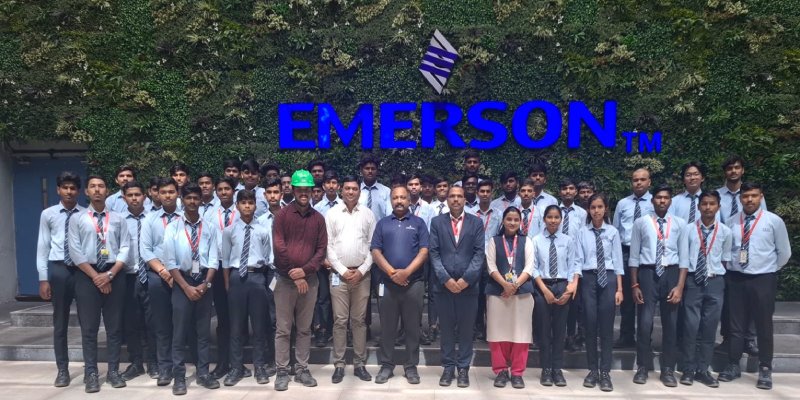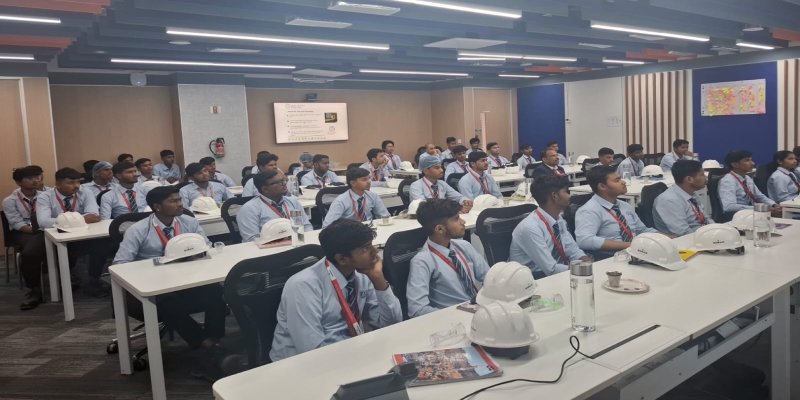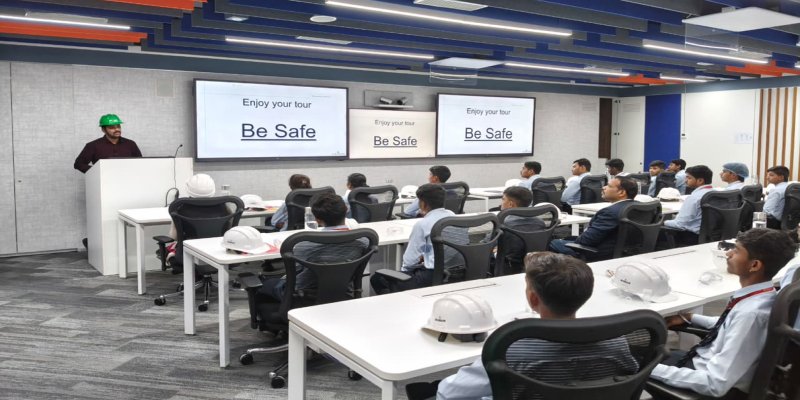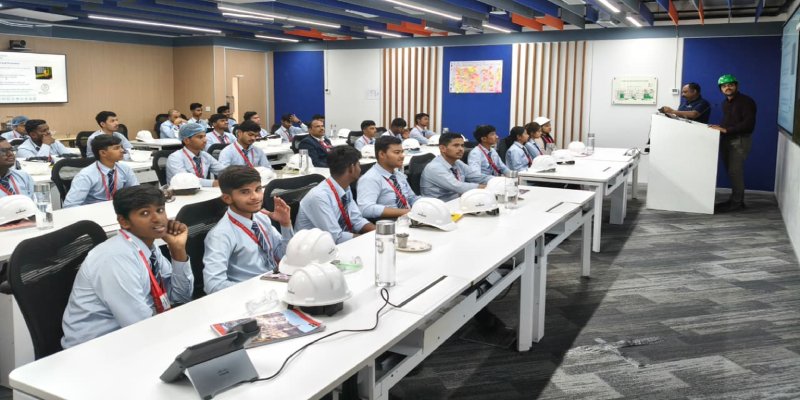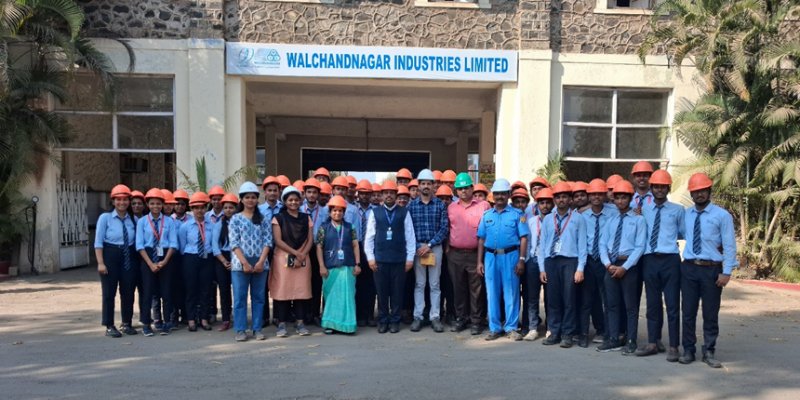

Resource Person:
- Jagdish Yadav (HR)
- Shital Kamate (Plant Head)
- Mr. Nikhil Chatane (Safety Head)
Industry Profile:
Emerson India Private Limited is a subsidiary of Emerson Electric Co., a global technology and engineering leader founded in 1890 in St. Louis, USA. Emerson operates worldwide and is well known for its expertise in industrial automation, process control, and digital transformation solutions.
The Emerson manufacturing facility at Talegaon MIDC, Maharashtra, plays a key role in supporting Emerson’s automation business in India and global markets. The plant focuses on producing high-quality automation and control equipment for critical industrial applications.
Emerson follows a customer-centric and innovation-driven approach, helping industries improve efficiency, safety, reliability, and sustainability. Its solutions are widely used in sectors such as oil & gas, power generation, water & wastewater, chemicals, pharmaceuticals, and manufacturing.
1. Core Products and Services
Emerson India Private Limited offers a wide range of industrial automation products and services, including:
- Control Valves & Actuators
Used to regulate flow, pressure, temperature, and level in industrial processes. - Industrial Automation Solutions
Complete automation systems for process monitoring, control, and optimization. - Measurement & Instrumentation Devices
Sensors and transmitters for pressure, flow, temperature, and level measurement. - Engineering & Project Support Services
Design, integration, testing, commissioning, and technical support for industrial projects. - After-Sales & Maintenance Services
Calibration, diagnostics, spare parts, and lifecycle support to ensure reliable plant operation. - The Talegaon plant contributes significantly to manufacturing, assembly, testing, and quality assurance of automation equipment.
2. Market Position & Achievements
- Emerson is a global leader in industrial automation and digital solutions, operating in 150+ countries.
- The company is widely trusted for high-precision, reliable, and safety-critical automation products.
- Emerson’s technologies are used in critical infrastructure and large-scale industrial plants
- In India, Emerson plays a vital role in modernizing industries and supporting the government’s Make in India and Industry 4.0
- The Talegaon facility strengthens Emerson’s manufacturing footprint and export capabilities.
3. Environmental & Social Impact
Emerson actively promotes sustainable and responsible industrial practices:
- Helps industries reduce energy consumption and emissions through efficient automation.
- Supports safe plant operations, reducing accidents and environmental risks.
- Encourages digitalization and smart manufacturing to minimize waste.
- Generates local employment and enhances technical skill development.
- Aligns its operations with global sustainability goals and ESG standards.
- Emerson’s solutions indirectly contribute to cleaner energy production, efficient water usage, and safer industrial environments.
4. Emerson Talegaon Plant – Overview
The Emerson Talegaon facility is an important manufacturing and engineering unit within Emerson India’s operations.
Key points of the Talegaon facility:
- Location: Talegaon MIDC, Pune district, Maharashtra
- Type: Industrial automation manufacturing and assembly unit
- Main Activities:
- Manufacturing and assembly of control valves and actuators
- Testing and quality inspection of automation equipment
- Engineering and technical support for domestic and export markets
- Purpose:
- Supply reliable automation products to process industries
- Support global Emerson projects
- Enhance India’s role as a manufacturing and export hub
The plant demonstrates advanced manufacturing practices, strict safety standards, and quality control systems, making it an ideal learning site for diploma and engineering students
Emerson India Private Limited, Talegaon, represents a modern industrial automation facility that integrates engineering excellence, advanced manufacturing, and sustainability. The industrial visit provided valuable insights into real-world applications of automation, control systems, and industrial safety practices, bridging the gap between classroom learning and industry requirements.
Products:
1. Isolation Valves (On–Off Valves)
Isolation valves are used to completely stop or allow flow. They are not primarily meant for throttling but for safe isolation of equipment and pipelines.
Ball Valves
Ball valves use a rotating spherical ball with a hole to control flow.
- Technical Features:
- Quarter-turn (90°) operation
- Tight shut-off (bubble-tight sealing)
- Low pressure drop
- Suitable for high pressure and temperature
- Applications:
Oil & gas pipelines, chemical plants, power plants
Butterfly Valves
- Butterfly valves control flow using a rotating disc inside the pipe.
- Technical Features:
- Lightweight and compact
- Economical for large diameter pipelines
- Quick operation
- Moderate sealing performance
- Applications:
Water treatment plants, HVAC systems, fire protection systems
Gate Valves
- Gate valves use a sliding gate to allow or block flow.
- Technical Features:
- Full bore opening → minimal pressure loss
- Not suitable for throttling
- Designed for fully open or fully closed condition
- Applications:
Power plants, water distribution systems, refineries
Plug Valves
- Plug valves use a cylindrical or tapered plug to control flow.
- Technical Features:
- Simple design
- Good sealing capability
- Suitable for viscous and slurry fluids
- Applications:
Chemical and petrochemical industries
2. Actuators Used with Isolation Valves
Actuators provide automatic operation of isolation valves, eliminating manual effort and improving safety.
(i) Pneumatic Actuators
Used With:
Ball valves, butterfly valves, plug valves
(ii) Electric Actuators
Used With:
Gate valves, ball valves, butterfly valves
(iii) Hydraulic Actuators
Used With:
Large isolation valves in oil & gas and power plants
Objective/Purpose:
- Understand the construction, working, and types of isolation valves such as ball, butterfly, and gate valves.
- Study different actuators (pneumatic, electric, hydraulic, and electro-hydraulic) used for automatic valve operation.
- Learn the integration of valves with actuators and positioners in automated control systems.
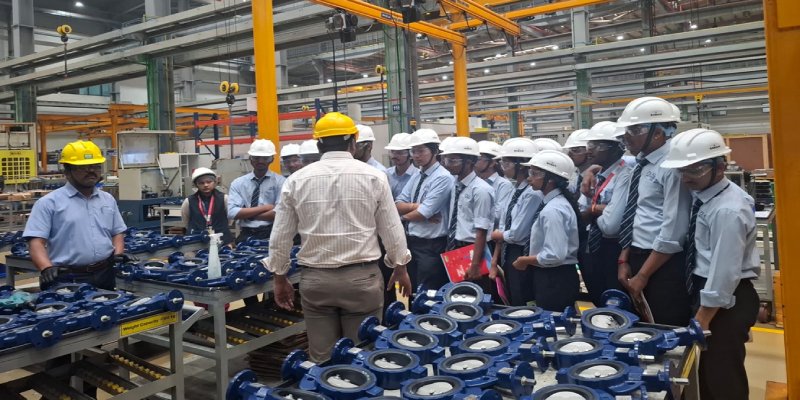
- Observe manufacturing, assembly, and testing procedures followed at an industrial level.
- Understand the importance of safety standards, quality control, and testing methods used in valve automation.
- Gain knowledge about industrial applications of valves and actuators in power plants, oil & gas, water treatment, and chemical industries.
- Bridge the gap between theoretical knowledge and practical industrial practices.
- Develop awareness about career opportunities in industrial automation and process control industries.