
Participants: Third Year Electronics & Telecommunication Engineering Students.
Summary:
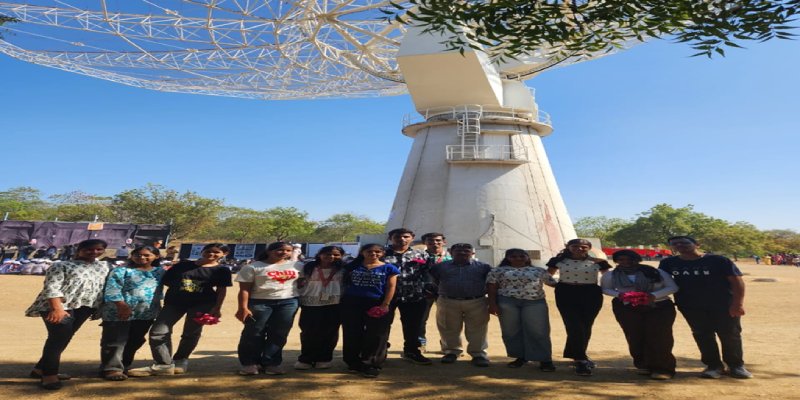
The Department of Electronics & Telecommunication Engineering organized an Industrial Visit for the Third Year (TY) students to the Giant Metrewave Radio Telescope (GMRT), located near Narayangaon. The objective of this visit was to provide students with practical exposure to modern communication systems, antenna technology, and radio astronomy applications. The Giant Metrewave Radio Telescope is one of the largest and most powerful radio telescope arrays in the world. It consists of 30 fully steerable parabolic dish antennas, each of 45 meters in diameter, spread over a distance of about 25 kilometers. The telescope is operated by the National Centre for Radio Astrophysics (NCRA), which is a part of the Tata Institute of Fundamental Research (TIFR). GMRT is widely used by scientists for studying cosmic radio waves, galaxies, pulsars, and other astronomical phenomena.
During the visit, students were guided by experts from GMRT who explained the structure and functioning of the parabolic dish antennas. Students observed how multiple antennas are connected to form an array communication system for capturing weak radio signals from space. The experts also explained topics such as RF signal reception, antenna alignment, data processing, and the role of advanced electronics in radio astronomy research. Students had the opportunity to see the control room and understand how signals received by antennas are processed and analyzed.
Objective/ Purpose:
- To understand the working of large antenna systems.
- To observe practical implementation of RF communication systems.
- To gain knowledge about signal processing in radio astronomy.
- To interact with experts and understand real-world engineering applications.
Outcomes:
The industrial visit to the Giant Metrewave Radio Telescope was highly informative and educational. It enhanced students’ understanding of modern communication technologies and research applications in radio astronomy. Such visits play an important role in bridging the gap between academic knowledge and practical industry exposure. Through this visit, students gained practical insights into:
- Antenna design and parabolic dish structures
- RF communication systems
- Signal processing techniques
- Real-world applications of electronics and telecommunication engineering.
The visit helped students connect theoretical concepts studied in subjects like Antenna & Wave Propagation, RF Communication, and Digital Signal Processing with practical applications.