
Resource Person:
- Satya Ranjan (HR)
- Vikram Patil (Lead – State Training)
Industry Profile:
1. Introduction to Suzlon Energy
- Suzlon Energy Ltd. is a leading Indian renewable energy company specializing in wind power solutions. It was founded in 1995 by Tulsi Tanti with a vision to harness wind energy and reduce dependency on conventional power sources. Over the years, Suzlon has grown into a global player in the wind turbine manufacturing and renewable energy sector, with presence in around 17–19 countries
- The company is headquartered at Suzlon One Earth, Pune, Maharashtra, India, a Platinum LEED and GRIHA 5-star rated green campus, reflecting its commitment to sustainability.
- Suzlon’s business model encompasses the full wind energy value chain, from feasibility studies and design to manufacturing, installation, and long-term operations & maintenance (O&M), commonly known as the “Concept to Commissioning” model.
2. Core Products and Services
Suzlon’s portfolio mainly includes:
- Wind Turbine Generators (WTGs): ranging typically from 1 MW to 3.15 MW models designed for various wind regimes.
- Wind Energy Solutions: end-to-end project execution including land acquisition, civil works, erection, commissioning, and grid integration.
- Operations & Maintenance Services (O&M): lifecycle support to maximize energy output and asset reliability.
- The company also has strong in-house R&D centres in India and Europe to improve turbine technology and efficiency.
3. Market Position & Achievements
- Suzlon is one of India’s top renewable energy companies and a major wind turbine manufacturer globally.
- The group has installed over 20,000+ MW of wind energy capacity worldwide.
- It has a significant service portfolio, managing over 8 GW of wind assets across India and abroad.
- The company’s technology is instrumental in advancing sustainable energy and reducing carbon emissions. It’s a key contributor to India’s renewable targets and energy security.
4. Environmental & Social Impact
Wind energy projects like those by Suzlon help:
- Reduce dependence on fossil fuels and associated emissions.
- Provide clean, renewable power to rural and urban grids.
- Support local communities with employment opportunities and infrastructure development.
- Suzlon’s operations align with global sustainability goals and India’s commitment to green energy growth.
5. Chalkewadi Wind Power Plant – Overview
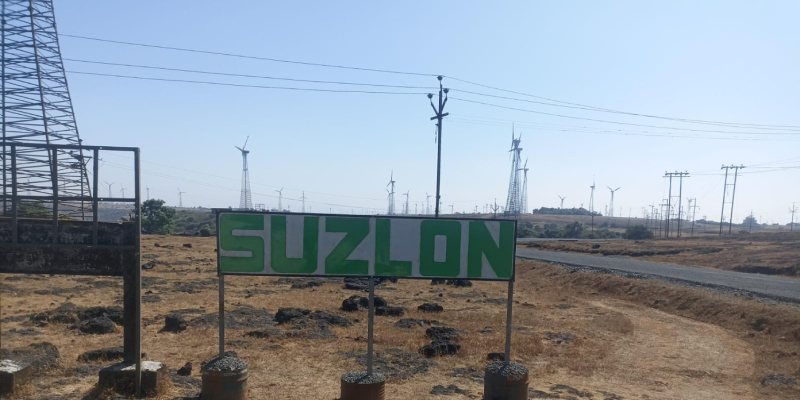
The Chalkewadi Wind Power Plant in Satara district, Maharashtra, is one of the prominent wind energy sites in the region. It forms part of a larger wind energy farm spread across the rolling hill plateaus near Satara, which is considered among the largest wind energy clusters in Maharashtra.
While the Chalkewadi site consists of several wind turbines (including Suzlon’s models such as S64/1250 and S33/350 among others), the entire wind farm comprises hundreds of turbines installed over a wide area to harness the strong wind resources of the region.
Key points about the Chalkewadi project:
- Location: Satara, Maharashtra.
- Type: Onshore wind power farm.
- Components: A mix of wind turbines of different capacities installed to optimize energy capture.
- Purpose: Generation of renewable electricity supplied to the state grid and local consumption.
The wind farm also contributes to transforming the landscape into an iconic renewable energy hub, visually attracting tourists and visitors interested in renewable technologies.
Products:
1. Wind Turbine Generators (WTGs)
- Suzlon’s core products are wind turbine generators (WTGs) — machines that convert wind energy into electricity. These turbines vary in size, power output, technology, rotor diameter, and tower height to suit different wind conditions and site requirements.
2. Main Product Range
A. S120 Series
- A 1 MW class turbine designed for high performance across a variety of wind sites.
- Features a 120 m rotor diameter and advanced control systems for energy optimisation.
- Used widely for commercial wind power projects in India.
B. 2.x – 3.x MW Series (Next-Gen Large Turbines)
These are Suzlon’s higher-capacity turbines that deliver more energy and enable low-wind site deployment:
- S133: A turbine with a larger rotor and increased capacity (2.6 – 3.0 MW), suitable for varied wind regimes.
- S144: One of Suzlon’s largest turbines with output up to 15 MW and improved energy yield, especially at higher hub heights (up to ~160 m).
These products help unlock harder-to-develop sites and significantly increase generation compared to older models. - Classic Fleet (Historical Models): – Suzlon’s earlier turbines (e.g., S97, S111, S82, etc.) formed the backbone of their installed assets worldwide. These continue to operate under service contracts even if manufacturing of some older models has phased out.
3. Key Features Across Products
- Designed to suit low, medium, and high wind regimes.
- Incorporate advanced DFIG (Doubly Fed Induction Generator) technology for efficient energy capture.
- Larger rotor diameters mean greater swept area and higher power generation.
- Tower heights and configurations (steel tubular, lattice-tubular) vary to optimise site-specific performance.
4. Services Related to Products
While turbines are the primary products, Suzlon’s also offers Operations & Maintenance (O&M) services, including multi-brand support, repairs, blade servicing, and performance optimisation — ensuring long-term, reliable operation of wind assets.
Objective / Purpose:
- To understand the working principle of wind power plantsand how wind energy is converted into electrical energy using wind turbine generators.
- To study the main components of a wind turbine, such as rotor blades, nacelle, gearbox, generator, tower, yaw mechanism, and braking system.
- To observe real-time operation and control systemsused for monitoring turbine performance, wind speed, power output, and safety parameters.
- To gain practical knowledge of installation and commissioning proceduresof wind turbines at a large-scale wind farm.
- To understand maintenance practices and safety measuresfollowed during operation, servicing, and troubleshooting of wind turbines.
- To learn about grid integration, power transmission, and how generated electricity is supplied to the state electricity grid.
- To create awareness about renewable energy and sustainability, and the role of wind power in reducing carbon emissions and dependence on fossil fuels.