
Resource Person/ Facilitator:
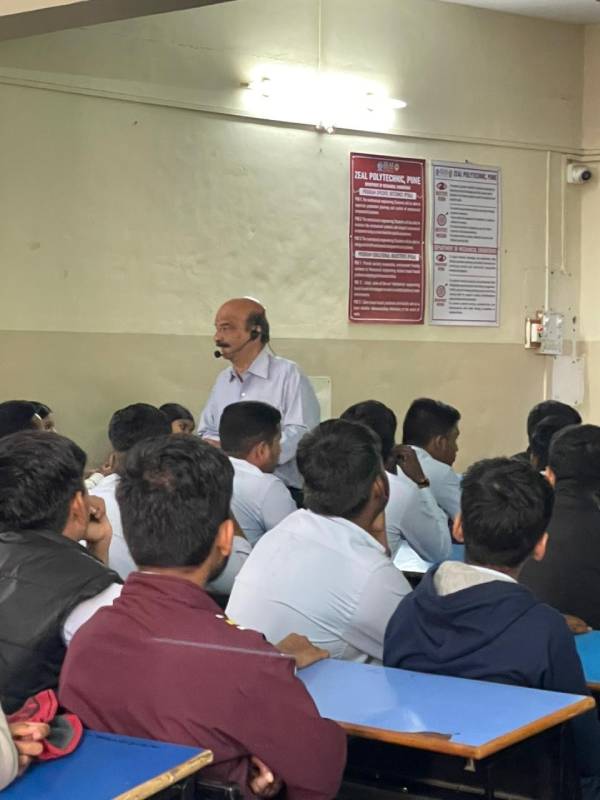
Mr. D. K. Mohan,
General Manager (Retired), NTB Hi-tech Ceramics, Chakan,Pune
Summary:
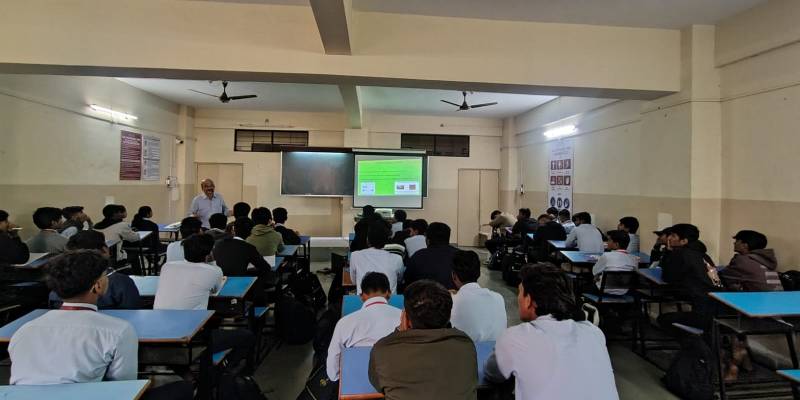
The Department of Mechanical Engineering organized a guest lecture on the topic “Material Selection for Critical Components: Steels & Cast Irons” for Second Year Mechanical Engineering students. The session was conducted by Mr. D. K. Mohan, an industry expert with over 35 years of experience in Sales, Marketing, Production, and Manufacturing. He has held leadership positions in reputed companies such as Larsen & Toubro, Chicago Pneumatic (Atlas Copco), Sandvik Asia, Dormer Tools, Snap-On Tools, Bahco, Lamina Tech., Bipico Tools, and NTB Hi-Tech Ceramics.
Key Highlights of the Session
- The session emphasized the importance of material selection in ensuring safety, reliability, and long service life of critical engineering components.
- A clear distinction was made between steels and cast irons based on their chemical composition, microstructure, and mechanical properties.
- Various types of steels (low carbon, medium carbon, high carbon, alloy steels, and stainless steels) were discussed along with their applications in shafts, gears, pressure vessels, and structural components.
- The lecture explained cast irons such as grey cast iron, white cast iron, malleable cast iron, and ductile (SG) cast iron, highlighting their suitability for machine beds, engine blocks, pipes, and housings.
- The role of mechanical properties—strength, hardness, toughness, ductility, and wear resistance—was highlighted as a key factor in selecting materials for load-bearing and high-stress components.
- Manufacturing considerationssuch as castability, machinability, weldability, and heat treatment were discussed while comparing steels and cast irons.
- The session covered failure modes like fatigue, corrosion, and wear, and explained how proper material selection can prevent premature failure of components.
- Cost, availability, and lifecycle economicswere identified as practical constraints influencing material choice in real-world engineering applications.
- Case studies from industry demonstrated how incorrect material selection can lead to component failure, increased maintenance, and safety risks.
- The lecture concluded by stressing the need for engineers to balance performance requirements, operating conditions, and economic factors while selecting steels or cast irons for critical components.
The lecture provided valuable industrial insights to the students, bridging the gap between academics and real-world applications. It motivated the newly admitted mechanical students to understand the scope, challenges, and future opportunities in manufacturing. The session concluded with an interactive Q & A, where students clarified their queries about industry expectations and career paths.
Objective/Purpose:
- To understand the fundamental differences between steels and cast irons.
- To study the mechanical and physical properties of various steels used in critical components.
- To identify different types of cast irons and their engineering applications.
- To analyze the effect of microstructure on material performance.
- To understand the role of heat treatment in improving material properties.
- To select suitable materials based on load, stress, and operating conditions.
- To evaluate manufacturing factors such as machinability and castability in material selection.
- To emphasize cost, safety, and reliability considerations in selecting materials for critical components.